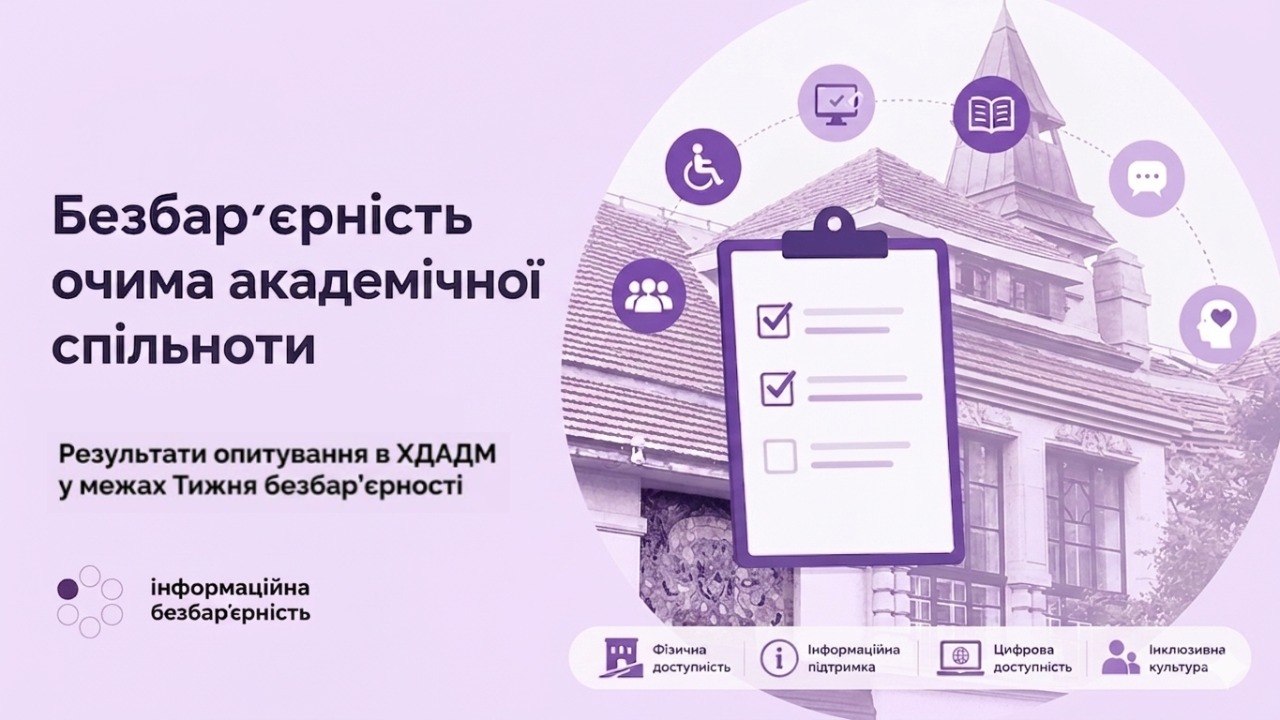




ACCESSIBILITY THROUGH THE EYES OF THE ACADEMIC COMMUNITY: SURVEY RESULTS AT KSADA
As part of the National Accessibility Week, a survey was conducted at the Kharkiv State Academy of Design and Arts among students, academic and teaching staff, as well as administrative and technical personnel.
The aim of the survey was to assess the level of awareness of the academic community regarding the principles of accessibility, to identify the main barriers faced by participants in the educational process, and to gather suggestions for creating a more accessible and inclusive educational environment.
The survey results indicated that the majority of respondents have a good or moderate level of awareness of the concept of accessibility and understand its components: physical, informational, digital, educational, social, and economic. Among the most pressing issues, respondents highlighted physical, informational, digital, communication, and socio-psychological barriers.
At the same time, some respondents stated that they had not personally encountered barriers within the Academy’s educational environment, indicating that significant progress has already been made in creating an inclusive and accessible space.
The results obtained will serve as an important foundation for further improving KSADA’s accessibility policy and implementing practical solutions aimed at creating a comfortable, accessible, and friendly educational environment for all members of the academic community.
We sincerely thank everyone who took part in the survey and shared their thoughts, suggestions, and vision for the future of an accessible barrier-free environment at KSADA.